Humectant vs Emollient vs Occlusive: The Science of Barrier Hydration
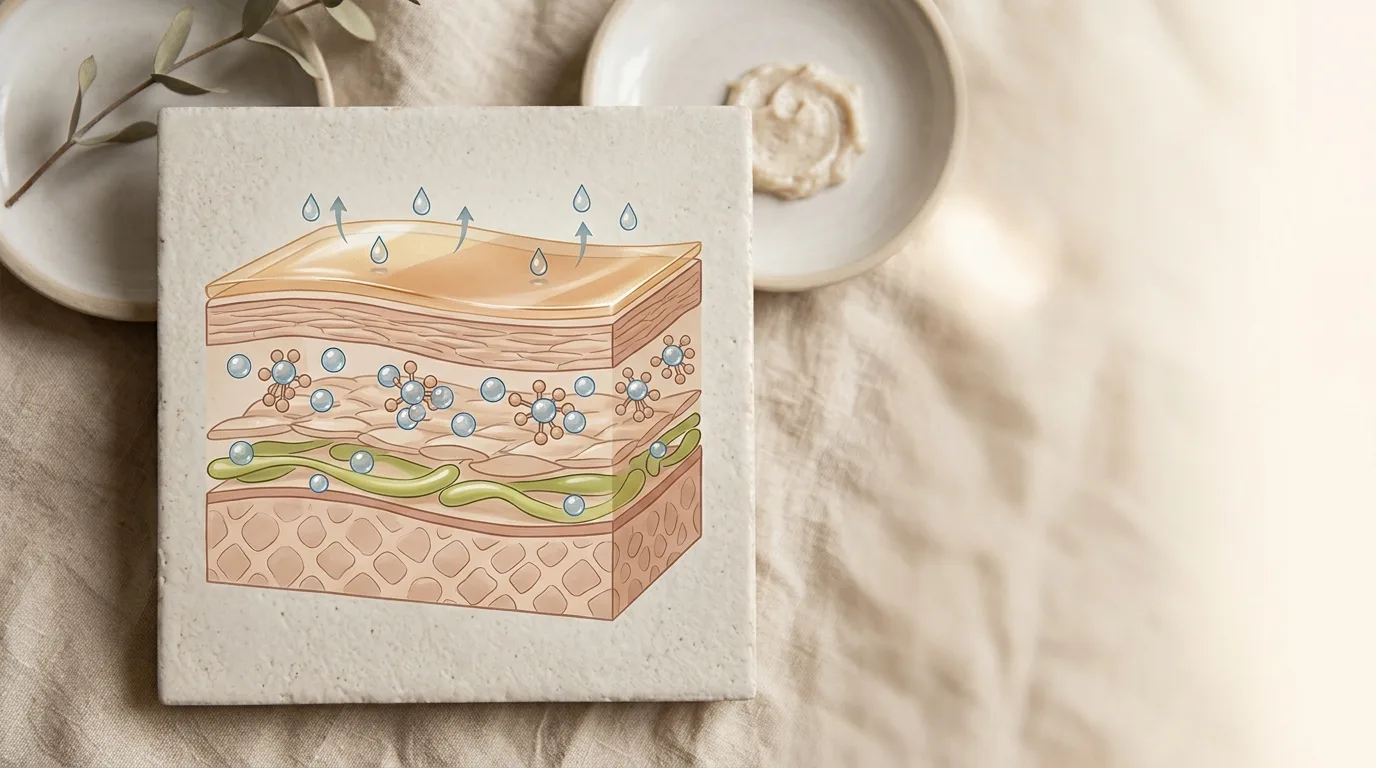
Humectants attract and bind water within the stratum corneum from the deeper epidermis or ambient atmosphere, emollients fill micro-fissures between corneocytes to restore surface suppleness and lipid architecture, and occlusives deposit an epicutaneous hydrophobic barrier that mitigates transepidermal water loss. Comprehensive skin barrier maintenance typically depends on the coordinated interplay of all three functional categories in balanced topical formulations.
Understanding the functional mechanics of humectant vs emollient vs occlusive ingredients is fundamental for evaluating topical formulations designed to sustain cutaneous hydration. The human skin barrier resides primarily within the stratum corneum, an intricate physiological structure frequently conceptualized as a brick-and-mortar wall. In this biological model, protein-rich corneocytes act as resilient bricks surrounded by an organized mortar of intercellular lipids consisting of ceramides, cholesterol, and free fatty acids. When the delicate equilibrium of this structure is disturbed by environmental stressors, chemical cleansing agents, or cosmetic procedures, cutaneous homeostasis falters, resulting in dehydration, flakiness, and an elevated rate of transepidermal water loss (TEWL).
Cosmetic science classifies moisturizing substances into three core physiological categories: humectants, emollients, and occlusives. Rather than functioning as competing philosophies, these three ingredient classes target distinct layers and biological mechanisms across the cutaneous tissue. By dissecting their physical properties, biochemical interactions, and spatial distributions, consumers and skincare professionals can make evidence-based decisions to preserve the appearance of healthy, supple skin.
What Are Humectants and How Do They Bind Water in the Epidermis?
Humectants represent water-soluble, low-molecular-weight molecules distinguished by their potent hygroscopic nature. Their primary biological mission is to draw water molecules into the stratum corneum, sourcing hydration either from the deeper, vascularized viable dermis via passive diffusion or directly from the surrounding external atmosphere when ambient relative humidity levels permit. Once absorbed, these molecules form non-covalent hydrogen bonds with water, trapping fluid within the superficial epidermal architecture.
Endogenous humectants constitute a crucial element of the natural moisturizing factor (NMF), an intracorneocyte collection of hygroscopic compounds generated during the enzymatic degradation of epidermal filaggrin. Topical urea serves as a physiological humectant and essential component of natural moisturizing factor that enhances stratum corneum hydration and reinforces barrier integrity 30378232, 27168272. At lower cosmetic concentrations, topical urea integrates directly into the natural moisture-binding matrix of corneocytes, increasing the water-binding capacity of the tissue and encouraging normal enzymatic desquamation without disrupting epidermal architecture 27168272.
Other humectant agents operate as macromolecular hydration reservoirs. Hyaluronic acid, a naturally occurring glycosaminoglycan, possesses an extraordinary capacity to bind up to 1,000 times its molecular weight in water. Advances in dermocosmetic chemistry have introduced modified polymer structures to stabilize this fragile molecule on the cutaneous surface. Specifically, crosslinked hyaluronic acid demonstrates sustained hygroscopic moisture retention and supports epidermal barrier function in dynamic cutaneous tissue models 27050698. By forming a viscoelastic, water-retentive web across the superficial stratum corneum, these advanced polymers provide continuous water delivery without interfering with cutaneous respiration.
Despite their biological utility, the clinical performance of humectants depends heavily on environmental context. In severely arid conditions, where the relative humidity drops below 40%, the ambient atmosphere contains insufficient vapor for hygroscopic capture. Under these dry ambient conditions, isolated humectants applied without accompanying barrier ingredients can accelerate the extraction of endogenous water from the living basal and spinous layers toward the desiccated surface, ironically increasing dehydration. Therefore, humectants rarely represent a comprehensive hydration strategy when formulated in isolation.
What Is the Structural Role of Emollients in Restoring Skin Texture?
While humectants manage water volume, emollients govern tissue texture, flexibility, and microstructural coherence. The uppermost layer of the skin undergoes continuous environmental and mechanical stress, which can deplete intercellular lipids and cause corneocyte desynchronization. Clinically, this manifests as rough, dull, peeling, or micro-fissured skin. Emollients are lipid-based or lipophilic compounds that function by physically occupying the microscopic gaps, crevices, and voids between shedding corneocytes.
By intercalating into the spaces between dehydrated surface cells, emollients restore structural continuity to the stratum corneum surface. This dynamic smoothing action softens rigid cellular margins, enhancing cutaneous pliability and providing an immediate sensory improvement in skin softness. Emollients encompass a broad chemical spectrum ranging from natural plant oils (such as squalane, jojoba oil, and caprylic/capric triglycerides) to synthetic esters, fatty acids (stearic acid, linoleic acid), fatty alcohols (cetyl and stearyl alcohol), and silicone fluids. Each class offers unique sensory profiles, spreadability factors, and lipid-replenishing characteristics.
Beyond superficial tactile improvements, specific physiologic emollients contribute directly to the organization of lamellar lipid sheets within the extracellular matrix. Advanced topical delivery technologies are necessary to optimize the cutaneous penetration and localized retention of moisturizing agents within the stratum corneum 28286978. When specialized vehicle systems deliver bioactive lipids into the superficial layers, these lipids assist the intercellular matrix in maintaining its ordered crystalline structure. This structural reinforcement prevents the formation of aberrant pathways through which water might otherwise escape, thus preserving cutaneous suppleness and an even visual texture.
How Do Occlusive Agents Mitigate Transepidermal Water Loss?
Occlusives function through an entirely physical mechanism: the deposition of an epicutaneous, hydrophobic barrier over the outermost layer of the stratum corneum. Rather than drawing moisture inward or integrating directly between cellular spaces, true occlusive agents establish an impermeable or semi-permeable film that physically obstructs the evaporation of water into the external atmosphere. By physically blocking the evaporative pathway, occlusives directly lower transepidermal water loss (TEWL).
Among traditional occlusive materials, petrolatum stands as the benchmark standard, capable of reducing TEWL by up to 98% under experimental conditions. Other prominent occlusive substances include mineral oil, microcrystalline waxes, dimethicone, lanolin, and plant-derived butters such as shea butter. While high-grade hydrocarbon agents offer unmatched mechanical vapor obstruction, contemporary dermocosmetic science often favors breathable semi-permeable occlusives, such as high-molecular-weight silicones and vegetable waxes, which suppress excessive evaporation while allowing normal oxygen exchange across the tissue.
Occlusion proves particularly essential in post-procedure skincare regimens or following mechanical and chemical trauma. Post-procedure application of topical moisturizing agents promotes stratum corneum recovery and supports barrier re-equilibration after superficial skin trauma 31322804. When superficial peeling agents, laser resurfacing, or abrasive exfoliants temporarily strip away the protective upper layers of the epidermis, the natural barrier against transepidermal evaporation is compromised. Applying topical occlusive barriers insulates the denuded cutaneous surface, maintaining a hydrated microenvironment that supports the skin's self-restorative cellular processes without causing irritation.
Humectant vs Emollient vs Occlusive: Why Is a Synergistic Approach Necessary?
When evaluating a humectant vs emollient vs occlusive framework, scientific consensus emphasizes that no single category can independently sustain optimal cutaneous hydration. Relying solely on one functional class inevitably leaves an aspect of the epidermal barrier vulnerable. As established, humectants without occlusive coverage can inadvertently pull moisture out of the deeper tissue in low-humidity environments. Conversely, pure occlusives applied over severely dehydrated skin merely trap an already deficient fluid volume without replenishing underlying moisture levels. Similarly, emollients applied in the absence of humectants may smooth the surface tactile feel without delivering sufficient hydration to maintain physiological resilience.
To visualize how these mechanisms interact throughout the tissue, optical characterization techniques provide objective evidence. Depth-resolved confocal Raman microscopy demonstrates that water gradients within the human stratum corneum vary significantly based on the presence and penetration depth of topical hydration agents 30932226. Research employing confocal Raman technology illustrates that the highest physiological water content resides within the deep, vital layers of the epidermis, decreasing steadily toward the superficial stratum corneum. The topical administration of multi-functional formulations stabilizes this natural gradient, preventing abrupt moisture drops at the surface and establishing a balanced hydration continuum from basal to superficial layers 30932226.
Modern formulation engineering relies on advanced carrier matrices, including liposomes, solid lipid nanoparticles, and multi-lamellar emulsions, to deliver these three ingredient families harmoniously. Advanced topical delivery technologies are necessary to optimize the cutaneous penetration and localized retention of moisturizing agents within the stratum corneum 28286978. In a sophisticated dermocosmetic formulation, humectants such as urea or hyaluronic acid are suspended within an aqueous phase to draw moisture into the cellular compartments 30378232, 27050698. Simultaneously, targeted emollients blend into the intercellular spaces, while protective occlusive materials form breathable barriers within the outer phase to preserve moisture balance.
| Functional Class | Primary Mechanism | Key Examples | Primary Target Site | |:--- |:--- |:--- |:--- | | Humectants | Attracts and hydrogen-bonds water molecules | Urea, Hyaluronic Acid, Glycerin, Sodium PCA | Corneocytes & deep stratum corneum | | Emollients | Fills microscopic gaps between shedding cells | Fatty acids, squalane, ceramides, cetyl alcohol | Intercellular spaces of stratum corneum | | Occlusives | Forms a hydrophobic vapor barrier to block TEWL | Petrolatum, dimethicone, beeswax, shea butter | Epicutaneous skin surface |
How to Select and Layer Topical Formulations
Applying products in an organized sequence optimizes the biochemical synergy between humectants, emollients, and occlusives. Skin care advice provided in pharmacy and dermatological settings typically follows the principle of molecular density, progressing from the lightest aqueous formulations to the most lipophilic, viscous products.
- Aqueous Humectant Application: Apply lightweight serums or toners containing hygroscopic agents (such as low-molecular-weight hyaluronic acid, glycerin, or urea) onto slightly damp skin immediately after gentle cleansing. This provides a direct reservoir of moisture for the molecules to bind without pulling water from deeper dermal layers.
- Lipophilic Emollient Integration: Follow with intermediate lotions or creams enriched with physiological lipids, fatty acids, and ceramides. These agents spread over the tissue, filling micro-fissures and replenishing the intercellular lipid mortar between corneocytes.
- Occlusive Epicutaneous Sealing: In compromised barrier states, dry climates, or nighttime regimens, finish with a richer cream or ointment containing occlusive ingredients like dimethicone, plant waxes, or petrolatum. This seals the underlying hydration into the stratum corneum and prevents ambient air from extracting critical moisture.
For individuals experiencing persistent dryness, redness, or barrier disruption, consulting a dermatologist or qualified healthcare provider is always recommended. A physician can assess the underlying cause of barrier impairment, exclude underlying dermatoses, and suggest appropriate topical care routines matched to individual skin characteristics.
Key takeaways
- Humectants attract and bind moisture within the stratum corneum, utilizing endogenous components like urea and hyaluronic acid to support hydration.
- Emollients fill the physical micro-fissures between corneocytes, smoothing surface roughness and reinforcing intercellular lipid architecture.
- Occlusives establish a hydrophobic surface film that mechanically mitigates transepidermal water loss (TEWL) and insulates repairing skin.
- Applying humectants without barrier-sealing occlusives in dry environments can exacerbate dehydration by drawing moisture out of deeper epidermal layers.
- Optimal skincare efficacy requires a balanced formulation strategy where humectants, emollients, and occlusives function synergistically.
Frequently asked questions
- Can applying humectants alone without an occlusive worsen skin dehydration in arid climates?
- Yes. When ambient relative humidity drops below 40%, humectants lack sufficient atmospheric moisture to bind. In the absence of an occlusive or emollient barrier, these hygroscopic molecules can extract water from the deeper living epidermis toward the surface, where it rapidly evaporates, inadvertently accelerating cutaneous dehydration.
- What structural differences distinguish emollients from true occlusive barriers?
- Emollients are primarily lipid-based agents designed to penetrate into the intercellular spaces between corneocytes, smoothing micro-fissures and improving tissue flexibility. In contrast, true occlusives do not primarily integrate between cells; instead, they deposit a physical hydrophobic film directly on top of the skin surface to mechanically obstruct water evaporation.
- How does urea function as both a humectant and a barrier-modulating agent?
- Urea is a low-molecular-weight physiological component of the natural moisturizing factor (NMF) that binds water via hydrogen bonding to hydrate corneocytes. At physiological cosmetic concentrations, it also aids in the gentle normalization of epidermal desquamation and supports skin barrier integrity.
- Why do dermocosmetic formulations combine humectants, emollients, and occlusives in a single product?
- A single functional category cannot independently sustain healthy barrier physiology. Humectants supply and bind water, emollients restore pliability and smooth cellular margins, and occlusives prevent that newly introduced moisture from evaporating via transepidermal water loss.
References
- Cosmetic use of three topical moisturizers following glycolic acid facial peels — Journal of cosmetic dermatology · 2020
- Topical urea in skincare: A review — Dermatologic therapy · 2018
- Seeking better topical delivery technologies of moisturizing agents for enhanced skin moisturization — Expert opinion on drug delivery · 2018
- Urea: A Clinically Oriented Overview from Bench to Bedside — Journal of drugs in dermatology : JDD · 2016
- Novel confocal Raman microscopy method to investigate hydration mechanisms in human skin — Skin research and technology : official journal of International Society for Bioengineering and the Skin (ISBS) [and] International Society for Digital Imaging of Skin (ISDIS) [and] International Society for Skin Imaging (ISSI) · 2019
- Pilot Comparative Study of the Topical Action of a Novel, Crosslinked Resilient Hyaluronic Acid on Skin Hydration and Barrier Function in a Dynamic, Three-Dimensional Human Explant Model — Journal of drugs in dermatology : JDD · 2016

This content is for information only and does not replace a medical consultation. Consult your doctor about your own situation.